
 ,
Fanta Sangho,
Djibril Barry,
Aminata Diangana,
Lancina Doumbia,
Abou Sogodogo,
Amadou Youssouf Toure,
Mamatal Ag Intagriste,
Mariam Traore,
Mouhamadou Traore,
Ousmane Doumbia,
Yaya Togo,
Abdoul Salam Diarra,
Borodjan Diarra,
Cheick Abou Coulibaly
,
Fanta Sangho,
Djibril Barry,
Aminata Diangana,
Lancina Doumbia,
Abou Sogodogo,
Amadou Youssouf Toure,
Mamatal Ag Intagriste,
Mariam Traore,
Mouhamadou Traore,
Ousmane Doumbia,
Yaya Togo,
Abdoul Salam Diarra,
Borodjan Diarra,
Cheick Abou Coulibaly
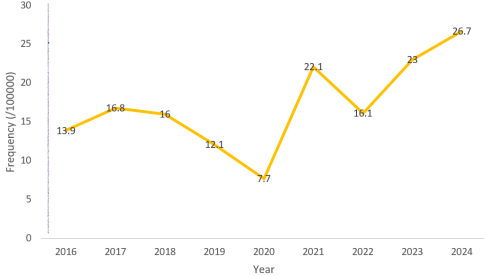
Introduction: Tuberculosis is a chronic infectious disease caused by Mycobacterium tuberculosis (Koch's bacillus) and remains a major public health problem in many developing countries. This study aimed to analyze tuberculosis data from the Niono health district in Mali from 2016 to 2024. Methodology: This was a cross-sectional study conducted using routine data collected from Referral Health Centers (CSRef) and selected Community Health Centers (CSCom) in the Niono district. The study covered data from 2016 to 2024. We analyzed annual incidence rates, the proportions of new cases and relapses, and mortality rates. Data confidentiality was maintained through coding throughout the study. Results: A total of 6,711 suspected TB cases, of which 718 were confirmed (a positivity rate of 10.7%), were recorded in the Niono health district database from 2016 to 2024. Tuberculosis incidence increased from 22.1 cases per 100,000 people in the Niono district in 2021 to 26.7 in 2024. The district saw a high proportion of incident cases in 2024 (19.3%). Notification to community health centers was the most common method, at 35.6%. The district experienced frequent relapses in 2019 and 2024 (18.8% and 18%, respectively). 99% of tuberculosis cases were treated at referral health centers. The mortality rate was estimated at 1.3%. Conclusion: Tuberculosis persists in the Niono health district, with the number of cases fluctuating and rising. The implementation of national strategies is necessary to achieve the objectives of a significant reduction.
| Published in | Science Journal of Public Health (Volume 14, Issue 2) |
| DOI | 10.11648/j.sjph.20261402.12 |
| Page(s) | 68-73 |
| Creative Commons |
This is an Open Access article, distributed under the terms of the Creative Commons Attribution 4.0 International License (http://creativecommons.org/licenses/by/4.0/), which permits unrestricted use, distribution and reproduction in any medium or format, provided the original work is properly cited. |
| Copyright |
Copyright © The Author(s), 2026. Published by Science Publishing Group |
Tuberculosis, Incidence, Niono District
Year | Health facilities | Total | ||||
|---|---|---|---|---|---|---|
CSCom | CSRef | |||||
n | % | n | % | n | % | |
2016 | 191 | 26.7 | 159 | 5.2 | 350 | 5.2 |
2017 | 45 | 6.3 | 352 | 11.6 | 397 | 5.9 |
2018 | 79 | 11.0 | 461 | 15.2 | 540 | 8.0 |
2019 | 36 | 5.0 | 378 | 12.4 | 414 | 6.2 |
2020 | 26 | 3.6 | 159 | 5.2 | 185 | 2.8 |
2021 | 29 | 4.1 | 193 | 6.3 | 222 | 3.1 |
2022 | 45 | 6.3 | 301 | 9.9 | 346 | 5.2 |
2023 | 103 | 14.4 | 399 | 13.1 | 502 | 7.5 |
2024 | 161 | 22.5 | 638 | 21.0 | 3755 | 55.6 |
Total | 715 | 100.0 | 3040 | 100.0 | 6711 | 100.0 |
Year | Health facility | Total | ||||
|---|---|---|---|---|---|---|
CSCom (n) | CSRef (n) | |||||
n | % | n | % | n | % | |
2016 | 6 | 10.2 | 40 | 5.6 | 46 | 5.9 |
2017 | 8 | 13.6 | 69 | 9.6 | 77 | 9.9 |
2018 | 7 | 11.9 | 71 | 9.9 | 78 | 10.0 |
2019 | 3 | 5.1 | 58 | 8.1 | 61 | 7.8 |
2020 | 7 | 11.9 | 33 | 4.6 | 40 | 5.1 |
2021 | 4 | 6.8 | 113 | 15.7 | 117 | 15.0 |
2022 | 3 | 5.1 | 84 | 11.7 | 87 | 11.2 |
2023 | 0 | 0.0 | 122 | 17.0 | 122 | 15.7 |
2024 | 21 | 35.6 | 129 | 17.9 | 150 | 19.3 |
Total | 59 | 100.0 | 719 | 100.0 | 778 | 1000 |

Year | Health facility | Total | ||||
|---|---|---|---|---|---|---|
CSCom (n) | CSRef (n) | |||||
n | % | n | % | n | % | |
2016 | 0 | 0.0 | 0 | 0.0 | 0 | 0.0 |
2017 | 0 | 0.0 | 0 | 0.0 | 0 | 0.0 |
2018 | 0 | 0.0 | 0 | 0.0 | 0 | 0.0 |
2019 | 0 | 0.0 | 138 | 18.9 | 138 | 18.8 |
2020 | 0 | 0.0 | 121 | 16.6 | 121 | 16.5 |
2021 | 0 | 0.0 | 116 | 15.9 | 116 | 15.8 |
2022 | 0 | 0.0 | 108 | 14.8 | 108 | 14.7 |
2023 | 0 | 0.0 | 119 | 16.3 | 119 | 16.2 |
2024 | 5 | 100.0 | 127 | 17.4 | 132 | 18.0 |
Total | 5 | 100.0 | 729 | 100.0 | 734 | 100.0 |
CSCom | Community Health Centers |
CSRef | Referral Health Centers |
DERSP | Department of Teaching and Research in Public Health and Specialties |
DHIS2 | District Health Information Software |
HIV | Human Immunodeficiency Virus |
INSP | National Institute of Public Health |
TB | Tuberculosis |
UCRC | 4University Clinical Research Center |
USTTB | University of Sciences, Techniques and Technologies of Bamako |
WHO | World Health Organization |
| [1] |
Global Tuberculosis Reports [Internet]. [cited 10 Nov 2025]. Available from:
https://www.who.int/teams/global-programme-on-tuberculosis-and-lung-health/tb-reports |
| [2] | Storla DG, Yimer S, Bjune GA. A systematic review of delay in the diagnosis and treatment of tuberculosis. BMC Public Health [Internet]. 14 Jan 2008 [cited 10 Nov 2025]; 8(1): 15. Available at: |
| [3] | Ministry of Health and Social Development of Mali. Technical Guide for Integrated Disease Surveillance and Response in Mali. 2022. |
| [4] |
World Health Organization. Tuberculosis [Internet]. [cited 10 Nov 2025]. Available from:
https://www.who.int/fr/news-room/fact-sheets/detail/tuberculosis |
| [5] | World Health Organization. African Region records further decline in tuberculosis deaths and cases [Internet]. 2025 [cited 10 Nov 2025]. Available from: |
| [6] | World Health Organization. Biennial Report 2022-2023: Main Results [Internet]. [cited 1 Dec 2025]. Available from: |
| [7] | WHO, Regional Office for Africa. Africa is making progress in the diagnosis and treatment of tuberculosis [Internet]. 2025 [cited 10 Nov 2025]. Available from: |
| [8] | MEASURE Evaluation. Support for Health Programs [Internet]. [cited 10 Nov 2025]. Available from: |
| [9] |
WHO Mali Annual Report 2018.pdf [Internet]. [cited 10 Nov 2025]. Available from:
https://www.afro.who.int/sites/default/files/2019-01/OMS%20MALI%20Rapport%20annuel%202018.pdf |
| [10] | World Health Organization. Mali celebrates World Tuberculosis Day 2012 [Internet]. 2012 [cited 10 Nov 2025]. Available from: |
| [11] | Revised Integrated National Strategic Plan 2023-2026 for the fight against HIV/AIDS, Tuberculosis and Viral Hepatitis in Mali. |
| [12] | Sectoral Unit for the Fight against HIV/AIDS, Tuberculosis and Viral Hepatitis, Mali. Annual Report 2024. |
| [13] | Niono Health District. Tuberculosis database 2016 to 2024. |
| [14] | Directorate General of Health and Public Hygiene. National Statistical Health Yearbook, Mali. 2023. |
| [15] | World Health Organization. 1.3 Drug-resistant TB [Internet]. [cited 1 Dec 2025]. Available from: |
| [16] | Sanogo M, Kone B, Diarra B, Maiga M, Baya B, Somboro AM, Sarro YS, Togo ACG, Dembele BPP, Goita D, Kone A, M'Baye O, Coulibaly N, Diabate S, Traore B, Diallo MH, Coulibaly YI, Saleeb P, Belson M, Orsega S, Siddiqui S, Polis MA, Dao S, Murphy RL, Diallo S. Performance of microscopic observation drug susceptibility for the rapid diagnosis of tuberculosis and detection of drug resistance in Bamako, Mali. Clin Microbiol Infect Off Publ Eur Soc Clin Microbiol Infect Dis. June 2017; 23(6): 408. e1-408. e6. |
| [17] |
Niaré B, Traoré Y, Keita C, Diallo O, Diarra S, Ba K, Touré S, Keita M, Coulibaly O, Traoré A, Diarra B, Traoré M, Coulibaly MB, Konake MS, Coulibaly AB. Active Screening for Tuberculosis in Sub-Saharan Africa: The Case of Mosques in the District of Bamako (Mali). SAS J Med [Internet]. 23 June 2023 [cited 1 Dec 2025]; 9(06): 704-8. Available from:
https://saspublishers.com/media/articles/SASJM_96_704-708_FT.pdf |
| [18] | Majdoub Fehri S, Daghfous H, Ben Saad S, Tritar F. Predictive factors for relapse of pulmonary tuberculosis. Rev Mal Respir [Internet]. 1 Jan 2017 [cited 1 Dec 2025]; 34: A234. Available from: |
| [19] |
Mjid M, Hedhli A, Zakhma M, Zribi M, Ouahchi Y, Toujani S, Cherif J. Clinical and microbiological profile of patients with relapsed tuberculosis in Tunisia. Rev Pneumol Clin [Internet]. 1 Apr 2018 [cited 1 Dec 2025]; 74(2): 76-80. Available from:
https://www.sciencedirect.com/science/article/pii/S0761841717301475 |
| [20] | Ansa GA, Walley JD, Siddiqi K, Wei X. Assessing the impact of TB/HIV services integration on TB treatment outcomes and their relevance in TB/HIV monitoring in Ghana. Infect Say Poverty. 24 Dec 2012; 1(1): 13. |
| [21] |
Ministry of Health and Public Hygiene. Mali NCD Strategic Plan 2019-2023, Non-communicable disease [Internet]. [cited 1 Dec 2025]. Available from:
https://fr.scribd.com/document/822242867/MLI-B3-s21-Plan-Strategique-MNT-VF-230319 |
| [22] | Coulibaly MB, Niangaly AA, Keita Z, Sylla O. Epidemiological, diagnostic, and evolutionary profile of tuberculosis in the community setting at the Konobougou diagnostic and treatment center, Mali. Rev Malienne Infect Microbiol [Internet]. 27 Nov 2020 [cited 1 Dec 2025]; 15(2): 43-7. Available from: |
| [23] | Ousmane SY, Karamoko Djiguiba, Cheickne Hamala Kome, Sidy Sangare, Fanta Niare, Lamine Doumbia. Epidemiological aspects of pulmonary tuberculosis in the Djenné health district, Mali. Journal of Epidemiology and Public Health, 2(4), 1-5 [Internet]. 2024 [cited 1 Dec 2025]. |
APA Style
Sangho, O., Sangho, F., Barry, D., Diangana, A., Doumbia, L., et al. (2026). Analysis of Tuberculosis Data in the Niono Health District in Mali from 2016 to 2024. Science Journal of Public Health, 14(2), 68-73. https://doi.org/10.11648/j.sjph.20261402.12
ACS Style
Sangho, O.; Sangho, F.; Barry, D.; Diangana, A.; Doumbia, L., et al. Analysis of Tuberculosis Data in the Niono Health District in Mali from 2016 to 2024. Sci. J. Public Health 2026, 14(2), 68-73. doi: 10.11648/j.sjph.20261402.12
@article{10.11648/j.sjph.20261402.12,
  author = {Oumar Sangho and Fanta Sangho and Djibril Barry and Aminata Diangana and Lancina Doumbia and Abou Sogodogo and Amadou Youssouf Toure and Mamatal Ag Intagriste and Mariam Traore and Mouhamadou Traore and Ousmane Doumbia and Yaya Togo and Abdoul Salam Diarra and Borodjan Diarra and Ousmane Boua Togola and Cheick Abou Coulibaly},
  title = {Analysis of Tuberculosis Data in the Niono Health District in Mali from 2016 to 2024},
  journal = {Science Journal of Public Health},
  volume = {14},
  number = {2},
  pages = {68-73},
  doi = {10.11648/j.sjph.20261402.12},
  url = {https://doi.org/10.11648/j.sjph.20261402.12},
  eprint = {https://article.sciencepublishinggroup.com/pdf/10.11648.j.sjph.20261402.12},
  abstract = {Introduction: Tuberculosis is a chronic infectious disease caused by Mycobacterium tuberculosis (Koch's bacillus) and remains a major public health problem in many developing countries. This study aimed to analyze tuberculosis data from the Niono health district in Mali from 2016 to 2024. Methodology: This was a cross-sectional study conducted using routine data collected from Referral Health Centers (CSRef) and selected Community Health Centers (CSCom) in the Niono district. The study covered data from 2016 to 2024. We analyzed annual incidence rates, the proportions of new cases and relapses, and mortality rates. Data confidentiality was maintained through coding throughout the study. Results: A total of 6,711 suspected TB cases, of which 718 were confirmed (a positivity rate of 10.7%), were recorded in the Niono health district database from 2016 to 2024. Tuberculosis incidence increased from 22.1 cases per 100,000 people in the Niono district in 2021 to 26.7 in 2024. The district saw a high proportion of incident cases in 2024 (19.3%). Notification to community health centers was the most common method, at 35.6%. The district experienced frequent relapses in 2019 and 2024 (18.8% and 18%, respectively). 99% of tuberculosis cases were treated at referral health centers. The mortality rate was estimated at 1.3%. Conclusion: Tuberculosis persists in the Niono health district, with the number of cases fluctuating and rising. The implementation of national strategies is necessary to achieve the objectives of a significant reduction.},
 year = {2026}
}
TY  - JOUR
T1  - Analysis of Tuberculosis Data in the Niono Health District in Mali from 2016 to 2024
AU  - Oumar Sangho
AU  - Fanta Sangho
AU  - Djibril Barry
AU  - Aminata Diangana
AU  - Lancina Doumbia
AU  - Abou Sogodogo
AU  - Amadou Youssouf Toure
AU  - Mamatal Ag Intagriste
AU  - Mariam Traore
AU  - Mouhamadou Traore
AU  - Ousmane Doumbia
AU  - Yaya Togo
AU  - Abdoul Salam Diarra
AU  - Borodjan Diarra
AU  - Ousmane Boua Togola
AU  - Cheick Abou Coulibaly
Y1  - 2026/03/27
PY  - 2026
N1  - https://doi.org/10.11648/j.sjph.20261402.12
DO  - 10.11648/j.sjph.20261402.12
T2  - Science Journal of Public Health
JF  - Science Journal of Public Health
JO  - Science Journal of Public Health
SP  - 68
EP  - 73
PB  - Science Publishing Group
SN  - 2328-7950
UR  - https://doi.org/10.11648/j.sjph.20261402.12
AB  - Introduction: Tuberculosis is a chronic infectious disease caused by Mycobacterium tuberculosis (Koch's bacillus) and remains a major public health problem in many developing countries. This study aimed to analyze tuberculosis data from the Niono health district in Mali from 2016 to 2024. Methodology: This was a cross-sectional study conducted using routine data collected from Referral Health Centers (CSRef) and selected Community Health Centers (CSCom) in the Niono district. The study covered data from 2016 to 2024. We analyzed annual incidence rates, the proportions of new cases and relapses, and mortality rates. Data confidentiality was maintained through coding throughout the study. Results: A total of 6,711 suspected TB cases, of which 718 were confirmed (a positivity rate of 10.7%), were recorded in the Niono health district database from 2016 to 2024. Tuberculosis incidence increased from 22.1 cases per 100,000 people in the Niono district in 2021 to 26.7 in 2024. The district saw a high proportion of incident cases in 2024 (19.3%). Notification to community health centers was the most common method, at 35.6%. The district experienced frequent relapses in 2019 and 2024 (18.8% and 18%, respectively). 99% of tuberculosis cases were treated at referral health centers. The mortality rate was estimated at 1.3%. Conclusion: Tuberculosis persists in the Niono health district, with the number of cases fluctuating and rising. The implementation of national strategies is necessary to achieve the objectives of a significant reduction.
VL  - 14
IS  - 2
ER  -
Department of Teaching and Research in Public Health and Specialties (DERSP), University of Sciences, Techniques and Technologies of Bamako (USTTB), Bamako, Mali
Department of Teaching and Research in Public Health and Specialties (DERSP), University of Sciences, Techniques and Technologies of Bamako (USTTB), Bamako, Mali
National Institute of Public Health (INSP), Ministry of Health, Bamako, Mali
Faculty of Health Sciences, Kankou Moussa University, Bamako, Mali
Department of Teaching and Research in Public Health and Specialties (DERSP), University of Sciences, Techniques and Technologies of Bamako (USTTB), Bamako, Mali
University Clinical Research Center (UCRC), University of Sciences, Techniques and Technologies of Bamako (USTTB), Bamako, Mali
Referral Health Center of Niono, Ministry of Health, Segou, Mali
Referral Health Center of Niono, Ministry of Health, Segou, Mali
Referral Health Center of Niono, Ministry of Health, Segou, Mali
Referral Health Center of Niono, Ministry of Health, Segou, Mali
Referral Health Center of Niono, Ministry of Health, Segou, Mali
National Institute of Public Health (INSP), Ministry of Health, Bamako, Mali
National Center for Scientific and Technological Research, Ministry of Higher Education and Scientific Research, Bamako, Mali
General Directorate of Health and Public Hygiene, Ministry of Health, Bamako, Mali
Department of Teaching and Research in Public Health and Specialties (DERSP), University of Sciences, Techniques and Technologies of Bamako (USTTB), Bamako, Mali



 Share This Article
 Twitter
 Linked In
 Facebook
 Copy
Copy Download